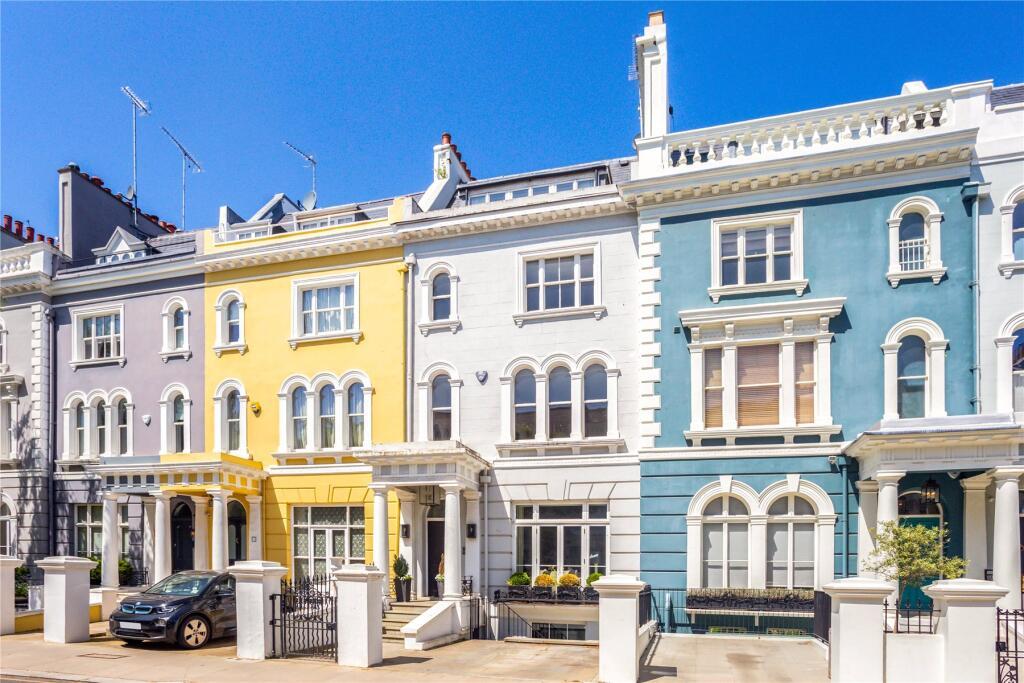
Four Areas, Four Sets of Rules
There is no Notting Hill Conservation Area. The name covers four designations, and an owner who reads the wrong appraisal will reach the wrong answer.
Ladbroke is the estate of sixteen private communal gardens, designated in 1969, built between 1821 and the 1870s in Italianate stucco. Pembridge, largely W2, is a brick area developed piecemeal rather than to a plan, with the borough's largest tree population. Colville, designated only in 2004, is the youngest and carries no Article 4 direction of its own. Norland is a single planned estate by Robert Cantwell, and the most tightly controlled residential area in Kensington and Chelsea.
The differences are not academic. Norland's Article 4 direction specifies paint colours by British Standard reference against your address. Ladbroke discourages picking cornices out in a contrasting white as a later invention. Norland's neighbourhood plan requires exactly that. The two estates adjoin.
The Communal Gardens Change the Back of the House
This is the single most expensive misunderstanding in Notting Hill, and it applies to a large part of Ladbroke.
Sixteen private communal gardens sit behind the terraces, all registered at Grade II. Because they were reached directly from the houses rather than across a road, the rear elevations were designed as formal elevations. The houses on Stanley Gardens have fully stuccoed rears with pilasters, capitals and curved bays. The Dutch-gabled houses on Lansdowne Road carry the same gables and arched windows at the back as at the front.
So on a garden-backing house, work to the rear is not permitted development. The Article 4 cover extends to rear elevations and to the boundaries facing the communal garden. A rear extension, replacement rear windows or a new garden boundary all need permission, and light pollution from oversized glazing into what the appraisal calls these valuable dark spaces is a named concern.
The gardens are run by elected residents' committees under either the Kensington Improvement Act 1851 or the Town Gardens Protection Act 1863, with the levy collected alongside Council Tax. Any scheme touching a garden boundary is a conversation with that committee as well as with the borough.
The Stock, and What It Is Hiding
Houses run from three storeys over basement, which is most common, to five in the largest houses on Ladbroke Gardens, Stanley Crescent and the south side of Elgin Crescent. Semi-detached villa pairs concentrate on Lansdowne Road and Clarendon Road.
Much of the Colville and Powis stock has been in multiple occupation since the 1880s. The Council itself converted twelve houses in Powis Square into flats after the First World War, and by 1922 only five of the forty-eight houses in that square were still in single occupancy. Expect altered plans, rerun services and openings that appear on no drawing.
Reuniting flats into a house is generally refused. RBKC's Policy HO1(B) does not allow the amalgamation of self-contained homes, with a narrow exception for combining a maximum of two where the existing flats are genuinely substandard.